Layered OKRs and Flight Levels: Make Every Task Traceable to Strategy
February 26, 2026 · 7 min read · Delivery & Systems Thinking
Most companies are "busy" but not moving the needle. Layered OKRs combined with Flight Levels give you a simple way to make every team work item traceable to a strategic objective.
Most organisations are full of activity but starved of impact. Strategy lives in slides, delivery lives in Jira, and the connection between the two is mostly hand‑waving.
Layered OKRs and Flight Levels give you a simple way to fix that: every work item a team picks up can be traced directly to a strategic objective.
Layered OKRs: Detail, Not Distance
A lot of OKR systems die because leaders treat them like a cascade of slogans.
By the time you get from company to team level, everything sounds nice but nothing is truly connected.
Good layering works differently: each level adds detail, not distance.
- Company OKRs describe long‑term direction and the few bets that matter this year.
- Group or product‑line OKRs break those bets into smaller, owned chunks.
- Team OKRs describe what this team will own this quarter to move those chunks.
A practical rule of thumb: the key results of a higher level become strong candidates for the objectives of the next level down. If you can't recombine the lower‑level OKRs back into the higher‑level one, you don't have a hierarchy, you have noise.
The test is simple:
"If this team hits their OKRs, can I clearly see which company outcome will move, and by roughly how much?"
If you can't answer that, you don't have layered OKRs yet. You just have parallel wishlists.
Flight Levels: A Simple Map of the Organisation
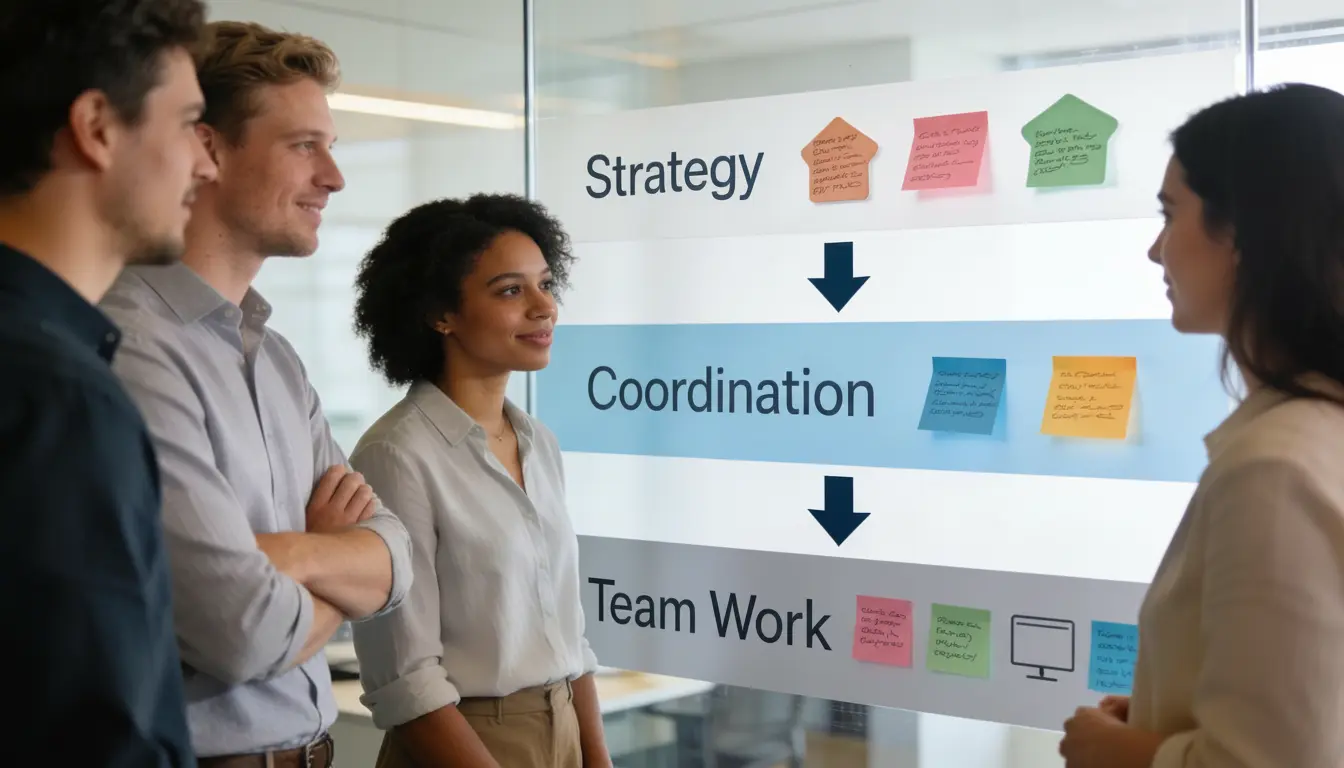
Flight Levels is a thinking model that makes strategy‑to‑execution flow visible across three "altitudes" of your organisation.
-
Flight Level 3 – Strategy
Long‑term strategic objectives and initiatives (often expressed as company OKRs) that define where you're going and why. -
Flight Level 2 – Coordination
Cross‑team coordination: managing initiatives, dependencies and capacity so multiple teams can move the same bet together. -
Flight Level 1 – Teams
Operational boards where teams manage their day‑to‑day work, sprints or flow of tickets.
Klaus Leopold's core point is that most organisations optimise at Flight Level 1 and then wonder why strategy doesn't move. Flight Levels forces you to design how work flows between levels, not just inside teams.
Layered OKRs fit cleanly into this:
- FL3 holds strategic OKRs and big initiatives.
- FL2 holds outcome‑focused slices of those bets that multiple teams contribute to.
- FL1 holds team‑level OKRs and the concrete work items that move them.
From Strategy to Task: An End‑to‑End Example
Let's make this concrete using a simple growth story.
Imagine you run a B2B SaaS product and want to grow revenue in MENA.
Flight Level 3: Strategic OKR
Objective (Company, FL3)
Grow MENA subscription revenue by 30% in 2026.
Key Results
- Increase free‑to‑paid conversion from 5% to 10%.
- Increase expansion revenue (upsell) by 20%.
This lives on your Flight Level 3 board as one of a small number of strategic bets.
Flight Level 2: Coordinating Outcomes
At Flight Level 2, you translate that strategic OKR into initiatives that require multiple teams.
For example:
-
Initiative A (FL2): "Double free‑to‑paid conversion via onboarding and pricing clarity."
Involves Growth, Product, Design, Data, and Marketing. -
Initiative B (FL2): "Increase expansion revenue via better in‑product upsell paths."
Involves Core Product, Sales Ops, and Customer Success.
Your FL2 board visualises these initiatives, which teams touch each one, and where work is stuck. This is where you avoid the classic "busy but not impactful" trap.
Flight Level 1: Team OKRs and Work Items
Now zoom into a single team that contributes to Initiative A.
Let's say this is the "Growth Web" team.
Objective (Team, FL1)
Make onboarding so clear that new users reach first value without friction.
Key Results
- Reduce drop‑off on onboarding step 2 from 40% to 15%.
- Increase 7‑day activation rate from 25% to 45%.
These team OKRs are owned and authored by the team, given the strategic context. They live on the team's own board at Flight Level 1 and are explicitly linked to Initiative A on the FL2 board.
Now look at actual work items the team pulls:
- "Redesign step‑2 form to remove non‑essential fields and inline errors."
- "Add pricing explanation tooltip and short video to reduce confusion."
- "Trigger tailored onboarding email when users stall for 48 hours."
Each ticket is tagged to one Key Result, which in turn is linked to Initiative A, which sits under the revenue growth OKR at Flight Level 3.
You've just created end‑to‑end traceability:
Task → Team KR → Initiative (FL2) → Strategic KR → Strategic Objective.
If someone asks "Why are we working on this ticket?", there is a real answer—not a vibe.
Practices That Make Traceability Real
This all sounds neat on paper. The hard part is making it work in a living organisation.
Here are practices that keep the wiring intact.
1. Make Strategy and OKRs Radically Visible
- Maintain a Flight Level 3 board showing strategic OKRs, initiatives, owners, and time horizons.
- Keep it open to everyone. Hidden OKRs kill alignment; visible ones create shared constraints.
The question you want engineers and designers to ask is:
"Which FL3 objective does my work roll up into?"
They shouldn't need a meeting invite to find out.
2. Design the Coordination Layer on Purpose
Most orgs have meetings instead of a coordination system.
Flight Level 2 fixes that.
- Create an FL2 board where initiatives live, with explicit links to FL3 objectives and FL1 teams.
- Use a regular cadence (weekly/bi‑weekly) to review flow, unblock dependencies, and adjust scope.
The goal is not more ceremony.
It's fewer surprises.
3. Let Teams Own Their OKRs
Teams shouldn't be handed fully‑baked OKRs from above.
They should be given strategic constraints and asked to design their own contribution.
Good prompts:
- "Given these FL3 OKRs and the initiatives on FL2, what outcomes can we credibly own this quarter?"
- "What can we stop doing so these outcomes are realistic?"
Involving the whole team in crafting KRs increases motivation and the quality of bets. You want engineers to argue about metrics, not just estimates.
4. Enforce a "No Orphan Work" Policy
This is where traceability becomes a habit, not a poster.
- Every backlog item must be linked to exactly one team KR (or a clearly defined "BAU / Keep the Lights On" bucket).
- In planning, you start from KRs: "What must move this sprint?"—then pull the highest‑leverage work items.
If a ticket has no KR, it doesn't get scheduled.
If a KR has no tickets, it's a slogan, not a commitment.
5. Report Progress Through the Layers
Avoid the trap of reporting activities ("shipped feature X") instead of outcomes.
- At Flight Level 1, teams review KR movement weekly or bi‑weekly.
- At Flight Level 2, you aggregate KR movement into initiative‑level health (e.g. "Onboarding conversion +3 points this month").
- At Flight Level 3, you review whether strategic KRs are on track and adjust bets, not just deadlines.
This creates a feedback loop: strategy talks to reality every few weeks, not every year.
6. Iterate the System, Not Just the Work
You will not design perfect OKRs or perfect Flight Level boards on the first try.
That's fine.
Klaus Leopold's advice is to treat this as an iterative system: test, learn, improve.
- Retrospect not only on sprints, but on how well the levels connected.
- Tweak the granularity of OKRs, the design of boards, and the cadences between levels.
- Make it safe to drop initiatives or KRs that turn out to be non‑levers.
Real impact doesn't come from perfectly drawn diagrams.
It comes from a system that holds under pressure.
Why This Matters for Product Leaders and Founders
If you're leading product or building a company, your job is to turn intent into reality.
You don't win by having "clear strategy" on a slide; you win when strategy shows up in Tuesday's tickets.
Layered OKRs ensure that lower‑level goals are real pieces of higher‑level goals, not abstract echoes.
Flight Levels gives you the operating system that connects those goals to the actual flow of work across teams.
Together, they give you something rare: a world where a single task on a team board can be traced all the way to a strategic objective—without needing a meeting, a Notion archaeology session, or a miracle.
That's when you know your organisation isn't just busy.
It's aligned.
And alignment is an unfair advantage.