Product, engineering, and UX · 2024 to 2025
Turn messy inputs into structured, high-quality resumes in minutes
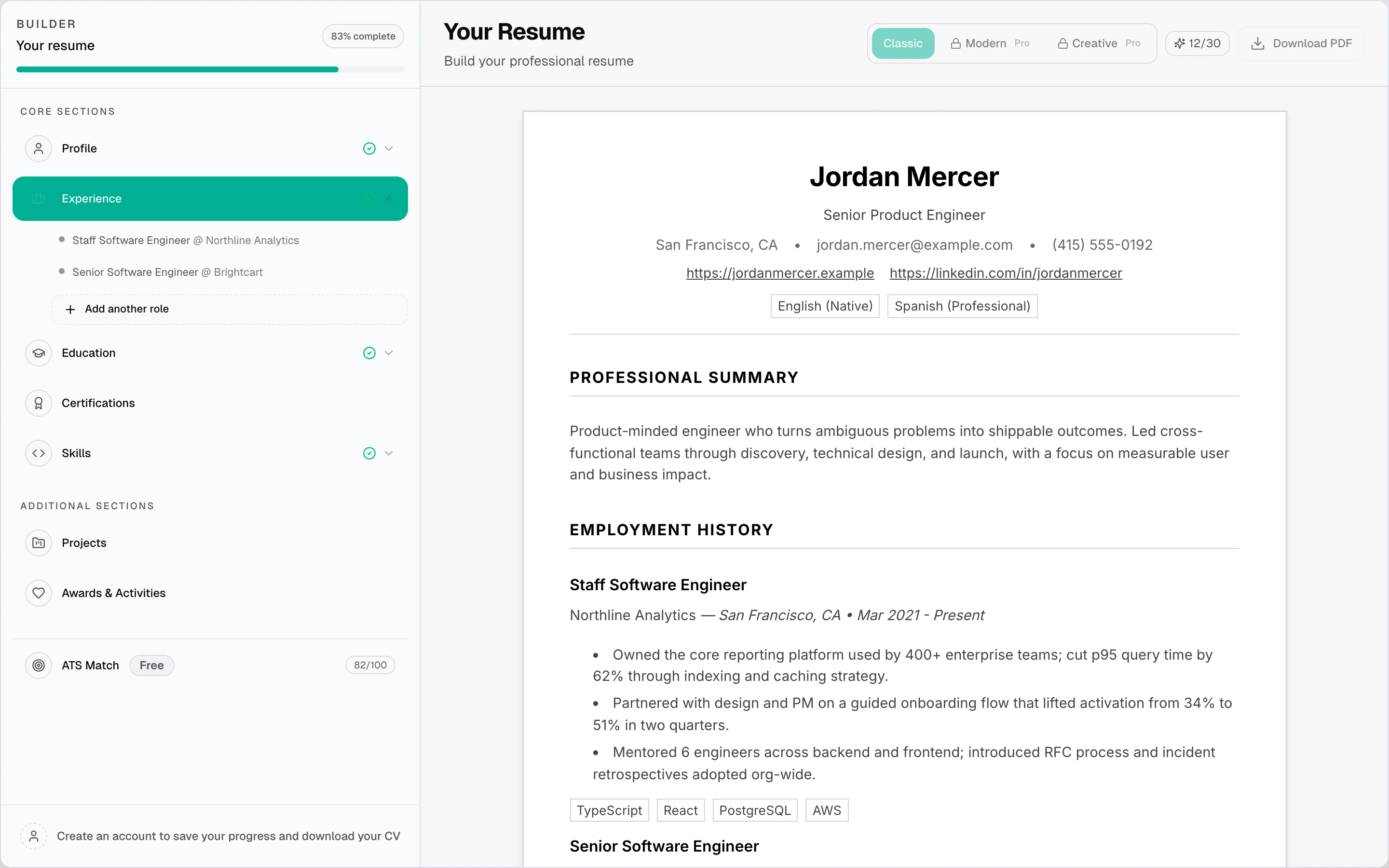
Syntheve transforms fragmented career history into ATS-ready CVs using AI-driven structuring and scoring.
From raw input to polished CV in under 5 minutes
Under 5 minutes
From raw notes to structured CV
ATS-aware output
Built to improve relevance, not just formatting
Truth-first AI
Grounded in user input to reduce hallucination
The problem I was solving
Messy inputs, weak guidance from tools, and low confidence in the final file.
Fragmented inputs
Users start with incomplete, messy, or inconsistent information about their own experience.
Poor decision support
Most tools either generate too loosely or present too little context to improve with confidence.
Low confidence
Users end up unsure whether the final CV is actually strong where it matters: clarity, impact, and fit.
Before and after
Same user intent. Different product experience.
- Blank-page anxiety
- Weak bullet points
- No ATS visibility
- Rewriting from scratch for every job
- Structured starting point
- Stronger, clearer bullet points
- Feedback against job relevance
- Multiple tailored CV versions
How it works
How I structured the pipeline
- 1
Capture raw experience
Users add work history, achievements, education, and skills in natural language.
- 2
Structure the data
The system breaks input into roles, responsibilities, impact statements, and supporting evidence.
- 3
Generate grounded content
AI transforms raw inputs into concise bullet points without inventing achievements.
- 4
Score and refine
The CV is evaluated against ATS-style criteria and improved iteratively.
- 5
Export with confidence
Users download a polished, role-ready resume.
What I shipped
Every feature keeps the CV grounded in what the user actually did.
Feature 01
AI-assisted bullet generation
Turn rough notes into stronger, clearer professional statements.
- Section-level control and review
- Concise, impact-oriented phrasing
- Edits stay tied to what the user actually provided
Feature 02
ATS scoring and feedback
Understand how a resume aligns to a role and where it can improve.
- Role-aware scoring signals
- Actionable gaps instead of opaque scores
- Iterate before you export
Feature 03
Version management
Create multiple tailored resumes without losing core profile data.
- Branch from a single source profile
- Compare versions quickly
- Tailor tone and emphasis per role
Feature 04
Skill normalization
Convert inconsistent or vague experience into clearer capability signals.
- Evidence-backed skill surfacing
- Consistent language across sections
- Less guesswork for recruiters and applicants
Outcomes
Faster first draft creation
Better CV clarity
Easier role tailoring
Improved feedback visibility
Key insights
What we learned building in production.
The hard work was translating experience into impact statements users would stand behind.
I got better results by constraining the model with structure than by leaving it open-ended.
ATS systems are less intelligent than people think, but still highly influential on design choices.
What makes this different
Most tools trade truthfulness for speed. Syntheve refuses the trade.
Traditional builders
Good templates, weak guidance
Generic AI tools
Fast generation, inconsistent truthfulness
Syntheve
Structured, grounded, ATS-aware refinement
Want a product like this built?
Syntheve is the kind of AI workflow I take through ROQ CX's four-week Build & Launch sprint: production auth, data, scoring loops, and a shippable slice you can put in front of users.
See the Build & Launch sprint- Fixed fee
- Four weeks
- Production codebase
Want to try the product itself? Try Syntheve